Kathy Stinson ~ Turning the Pages

Canadian Author of Books for Young People
Facebook Pinterest Goodreads Subscribe to RSS Feed Subscribe by email
  • Home
  • Books
    • Order a Signed Copy
    • E-Books
    • Stories in Anthologies
    • Activities
    • Awards
  • Author
    • Interviews
    • As Editor
    • Short Bio & Hi Res Photo
  • News
  • Presentations
    • School and Library Visits
    • Conferences
    • Teachers’ Professional Development
    • Book Clubs
    • Skype Meetings
  • Workshops
    • For Kids, Teens and Adults
    • Seaside Workshop / Retreat
    • In Liberia
  • FAQs
  • Contact

Meeting Joshua Bell

By Kathy · Comments (0)
Wednesday, June 12th, 2013

What an evening! On June 5, I attended a concert at Roy Thomson Hall featuring Joshua Bell as guest virtuoso violinist. Hearing and watching him play his multi-million- dollar Strad was even more exhilarating than I’d imagined it could be when I wrote these words (in my upcoming fall book, The Man with the Violin):

“The high notes soar to the ceiling. The low notes swoop to the floor. All the notes swirl and sweep around the blur of people rushing here and rushing there. The music is telling an exciting story. It makes the hairs on the back of Dylan’s neck tickle.”

The timing of Joshua Bell’s recent appearance in Toronto couldn’t have been better. The book had gone to press, the audio reading for the e-book version had been recorded, a video interview with me and the book’s illustrator had been produced, and Annick Press had produced advance copies of the book for American sales reps, and set one aside for me to give to Joshua Bell after his performance.

Conductor Peter Oundjian described Edgar Meyer’s Concerto for Violin and Double Bass as “a delightful romp”. And it was. At times it seemed the two instruments were arguing with each other. At others the instruments seemed to intertwine. And then there were the crossovers, for lack of a better word, when each instrument produced sounds one expects the other instrument to make.

Joshua Bell reading the book he inspired “The Man with the Violin” with author Kathy Stinson

Joshua Bell’s solos in Maurice Ravel’s Tzigane, rapsodie de concert for Violin and Orchestra was thrilling to hear and to watch. Notes so quiet you had to wonder how it was possible to produce a sound so sweet and then the great gusto of what I can’t help but describe as frenetic attacks on the strings. How was it physically possible, I wondered, to do with that priceless instrument what this “man with the violin” did!?

During the onstage Q&A after the concert, we learned that Joshua Bell has a 5 year old son who is learning the cello. (More on that, perhaps, in a future post.) And when I met with him backstage when the formal part of the evening was over, I learned that he also has two 3 year olds. Why is it I love this guy even more, knowing he’s a dad?

Joshua had seen the text and the illustrations for The Man with the Violin before I met him and gave him his advance copy (he had to, to know what kind of Postscript he would write for it). But I think when he held the actual book in his hands, he was as delighted with it as I was. He called it “a sweet book”. And after meeting him, I have to say, Joshua Bell is one sweet man.

Comments (0)
Categories : Kathy Stinson Books
Tags : Joshua Bell, The Man with the Violin

What 1 Movie & 2 Short Stories Taught Me About Writing

By Kathy · Comments (0)
Wednesday, June 5th, 2013

What We Talk About When We Talk About Love – stories by Raymond Carver After I saw the Australian movie Jindabyne recently, I decided to read the Raymond Carver short story on which the movie is based. It was fascinating to see how Beatrix Christian adapted the short, spare text of “So Much Water So Close to Home” to create a compelling 2-hour movie.

So often when we see movie adaptations of novels, we lament what’s been lost, even when it’s obvious something must be sacrificed when going from 500 pages of text to 90 minutes of film. Beatrix Christian’s task obviously was more of a fleshing out of what Raymond Carver left unsaid, between the lines, in his story. A talented pair of writers, both of them.

Having completed the one story, I had to read the rest of the collection, What We Talk About When We Talk About Love. One story in particular blew me away with what Raymond Carver, again, with his tight, tight writing, left unsaid.

The story “The Third Thing That Killed My Father Off” begins:

I’ll tell you what did my father in. The third thing was Dummy, that Dummy died. The first thing was Pearl Harbour. And the second thing was moving to my father’s farm near Wenatchee.

We then get the thing about Dummy, but no more is said about the move or Pearl Harbour until the last paragraph:

But as I said, Pearl Harbour and having to move back to his dad’s place didn’t do my dad one bit of good, either.

Is it possible to read those lines and not wonder what it was about Pearl Harbour and about that move that did that narrator’s father in? Arriving at the end of “The Third Thing…”, I was reminded of one of my favourite writing quotes (which I used in an earlier post – “The Joy of Cutting Words”):

The last thing that a poet learns is how to throw away,
And how to make you thrill and creep with what he doesn’t say.
– J.R. Lowell

Comments (0)
Categories : Writing
Tags : Beatrix Christian, Raymond Carver

Whose Point of View?

By Kathy · Comments (0)
Wednesday, May 22nd, 2013

A writer has many things to think about, including which character’s viewpoints are needed to tell a particular story. Like many writers, I’m drawn to stories told from multiple points of view. I think this is because, as writers, we’re fascinated with the different ways people perceive and experience the world, and how that influences their behaviour. We may also be keen to see events from all sides. But which of many possible viewpoints are needed to tell a particular story is a question all writers must inevitably face.

At one point in the writing of What Happened to Ivy, I’d written scenes from the points of view of a number of key people: Ivy, an eleven year old girl with multiple disabilities; David, her teenage brother; their father, Stephen; and David’s friend, Hannah.

First to go as I continued working on the manuscript was Stephen. He’s still in the novel, of course. There would not be a story without the role he plays in it. I may have needed to be in his head for a while myself to help me figure out just what his role was and how he felt about it, but, I decided, readers did not need to go there.

The next point of view to go was Hannah’s, even though for some time I thought What Happened to Ivy was her story. I won’t go into why, but it made sense to me at the time. Her pov was harder for me to let go of than Stephen’s.

Hardest of all to let go of was Ivy’s point of view. I loved Ivy and I loved how trying to imagine myself into her life helped me get to know her. But again readers didn’t need to go inside her head. Not only did they not need to, but as was the case with Stephen,  being inside her head would have undermined reader identification with David. Better for readers to experience the events of that important summer in David’s life strictly as he would have experienced them.

That said, I’d like to offer up one of Ivy’s scenes which, whether you’ve read What Happened to Ivy yet or not, won’t spoil anything for you.

Ivy can’t move. Daddy is holding her too tight.

   Mommy comes closer. She says the medicine tastes like cherries. It doesn’t.

   Ivy keeps her mouth closed. She kicks. She tries to roll over like Shamus. But Daddy says, “Damn it, Ivy,” and holds her tighter.

   Daddy is strong. It hurts when he holds her tight. It hurts her back and it hurts her arms and it hurts her head and she has to cry. And when she does, Mommy sticks the medicine in the back of her mouth. It smells like David’s armpits before his shower and it tastes like garbage and metal. Ivy wants to spit it out, but she can’t.

“All done,” Daddy says. He puts her in her wheelchair. He pushes her to the window.

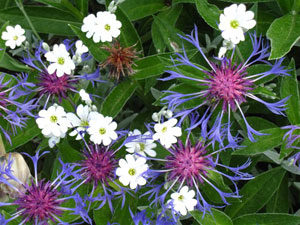
Outside is green. The birds are brown. The red birds are all gone. But there are red flowers. Big red flowers that look like Mommy’s smile when she wears lipstick. And tall blue flowers. And yellow flowers that look like the sun in one of her books. And teeny tiny little blue flowers. under all the big flowers and in other parts of the garden too.

David is in the garden on his knees. He looks up.

Ivy waves. Her back hurts. So does her neck. And so does her head.

David waves back.

Hannah comes across the street. She waves to Ivy in the window too. Ivy waves back.

David and Hannah talk.

Hannah waves bye-bye. Bye-bye is not like hi.

David calls, “Hannah, wait!”

Hannah comes back. David hands her a bunch of the teeny tiny little blue flowers. David likes Hannah.

When Hannah is gone, David looks up at Ivy’s window. He waves.

Ivy waves back. Her head hurts. So does her neck. And so does her back.

Haven’t read What Happened to Ivy yet? It was named a CLA Honour Book this spring so maybe you should!

Image courtesy of Master isolated images / FreeDigitalPhotos.net

Comments (0)
Categories : Kathy Stinson Books, Writing
Tags : point of view characters, What Happened to Ivy

Introducing: The Man With the Violin

By Kathy · Comments (4)
Wednesday, May 8th, 2013

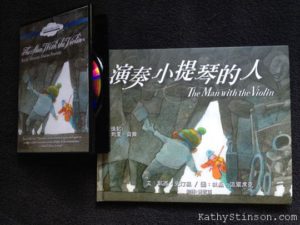
It started with a forwarded email late in 2011, containing a link. By February 2012, I had sent to Annick Press a manuscript for a picture book version of the story that had so captivated me . By August, Dušan Petricic was on board to illustrate a much crisper version of the story than what I’d originally submitted. It has already been well received at the Bologna Book Fair, even before publication. And last week it has gone to press! (It will be available in September 2013.)

The Man With the Violin

Look carefully at the cover to find out: who is that man with the violin?

Comments (4)
Categories : Kathy Stinson Books
Tags : Dušan Petri?i?, Joshua Bell

Stuff bloggers have said about Me

By Kathy · Comments (2)
Wednesday, April 24th, 2013

“Kathy Blogged” has disappeared from the Author menu on my website. Those words never quite captured what they were trying to say: Here are some blogs where Kathy Stinson is mentioned. But rather than just see some of the neat things bloggers said totally disappear, I decided to put a few of them into a blog of my own.

Jan L. Coates

Here’s Jan Coates, author of The Hare in the Elephant’s Trunk, blogging about “Killing off your darlings”. (The writer in the photo, taken by Erin Thomas, is also Jan.)

Here’s Erin Thomas, author of Haze, blogging about “Ten Honest Things” in which she mentions a few blogs she likes (including mine; I like hers too).

Here’s a blog my sister wrote when I first went to Liberia to work with writers there. I include it here in hopes of inspiring interest in Laptops for Liberia. My sister is also my Organized Assistant. It was her idea to put these blog mentions together here.

Tudor Robins, whose first book Objects In Mirror will be out soon, mentioned me in her next-to-last post of 2012.

This last one is not exactly a blog but I couldn’t resist tucking it in here. It’s a 5-minute audio podcast that Annick Press produced, during which I chat about Red is Best and a grade one boy in Lethbridge, Alberta, my grandson and A Pocket Can Have A Treasure In It, and how reading helped turn me into a writer.

Comments (2)
Categories : Kathy Stinson Books, Liberia, Writing
Tags : Erin Thomas, Jan Coates, Janet Barclay, Red Is Best, Tudor Robins

Photo of the Month #11

By Kathy · Comments (0)
Wednesday, April 10th, 2013

I wasn’t crazy about writing when I was a kid, but I did like it when the teacher gave us a picture as a starting point, especially if the picture inspired questions. Who? What? Where? And the best one: Why?

What would I have written if she’d given us this photo (which she couldn’t have because I shot it just this weekend)?

shoes in the woods

What’s the story here? What do YOU think?

Comments (0)
Categories : Photography, Writing
Tags : inspiration, photos

Thank You, Terry Fallis!

By Kathy · Comments (6)
Wednesday, March 27th, 2013

Amprosia While waiting for editorial feedback on What Happened to Ivy last winter, I started work on some short stories, thinking they might be less overwhelming – more easily broken into smaller chunks of work – than another novel would be, even if I was aiming to have enough stories, eventually, for a collection. Of course when I decided the stories would all be linked in some way beyond their theme, but each story would also stand well on its own, things got a bit complicated, as complicated as they do when writing a novel, maybe moreso.

As I’ve worked on this project, I’ve invited feedback from writer-friends, to see how well some of the individual stories are working (or not) as stand-alone stories. I’ve also been submitting a few finished pieces to contests.

Early this winter The Writers’ Community of Durham Region informed me that my entry in their contest (Amprosia) was one of nine stories that would go on to the final round of judging. Those nine stories would be judged by Terry Fallis, author of Best Laid Plans and others. ‘Great,’ I thought. ‘Maybe there is actually a point to the work I’m doing here.’

The day the winners were to be announced, those attending WCDR’s monthly meeting heard that Terry Fallis had this to say of the finalists’ stories:

‘They were all crafted by very talented writers who know how to sculpt sentences and assemble them into compelling and memorable stories.’

It was worth it to attend, just to hear those words of praise for my efforts. But then I heard these words about the second prize winner:

“The idyllic country setting in this piece was very well conveyed. Even as a city boy, I could easily picture the rolling fields; in fact, I felt like I was there.’

Hmm. My entry was set in the country…

‘This story packs an emotional punch rendered more potent in this writer’s hands. You enter this story effortlessly and don’t realize how invested you are until your heart lurches in final lines. It takes a skilled hand to draw a reader in without them really noticing.’

Oh, how I hoped – I dared hope – Terry’s words were about my story.

‘If you’re a parent, you may read this through different eyes, and feel the climax a little longer.”

Indeed, my story – “Zogler from Levitron” – was Amprosia’s second prize winner! Hurray!

There’s nothing quite like feedback from a writer of Terry Fallis’s stature to send a writer back to work with a renewed sense of energy and purpose. I may just finish this collection by the end of this year! And if not, well, maybe I’ll be entering next year’s Amprosia contest, too.

Please wish me luck, and if you’ve got a project on the go, I wish you all the best with it too.

By the way, the visual for this post is the cover of the anthology this year’s finalists will appear in, once the text “Edited by Heather M. O’Connor” has been put in place.

Comments (6)
Categories : Writing
Tags : short story, writing short stories

Writing Picture Books

By Kathy · Comments (0)
Wednesday, March 13th, 2013

Writing Picture Books: What Works and What Doesn’t Need help with your picture book manuscript?

From the introduction to the updated e-book version of Writing Picture Books: What Works & What Doesn’t:

Many books aim to help writers write better books, but not many with the specific purpose of helping writers write better picture books. Why is this?

Because writing picture books is too easy for anyone to need help doing it?

Because what makes a picture book successful is its pictures?

Because what makes a picture book appeal to readers is too elusive to grasp?

Anyone who has tried writing a picture book, and with a vague sense of dissatisfaction with the result relegated it to the bottom of a drawer, knows that writing a picture book is not easy. Anyone who, with confidence and high hopes, has sent a picture book manuscript to a publisher, only to see it returned with a form letter saying, ‘Thanks, but no thanks’ knows it, too. Anyone with a collection of such manuscripts and rejection letters certainly knows that writing a picture book is not easy.

Writing any book is not easy, but picture books present unique challenges that make the task more difficult than most people expect, given how short and apparently simple they are.

Just what are the challenges? How can you successfully meet them? Order the book now for less than you may have spent submitting (unsuccessfully) your picture book manuscript.

C$6.99

To complete your purchase, click on the Shopping Bag that will appear in the lower right corner of your screen. Tax will be added once you have entered your payment information. The PDF file will be delivered to your inbox shortly.

Comments (0)
Categories : Kathy Stinson Books, Writing
Tags : books about writing, resources for writers, writing children's books

Author Interview

By Kathy · Comments (0)
Wednesday, February 27th, 2013

What Happened to Ivy An interview for The Winnipeg Review – ‘Profound Disability, Ably Explored‘ – offers insights into the writing of What Happened to Ivy.

Thanks, Marsha, for posing such thought-provoking questions!

Comments (0)
Categories : Kathy Stinson Books
Tags : interview, What Happened to Ivy

Photo of the Month #10

By Kathy · Comments (0)
Wednesday, February 20th, 2013

It’s easy to love the colours of a Caribbean sea, captured during my first ever vacation to a warm place last month.

Caribbean sea

But there’s beauty to be found in the often monochromatic world of a Canadian winter too. On the first day of this winter, I was struck by the bits of ice forming on the branches that overhung a widening of the river near my home and the pattern they made. (My dog was more interested in the sticks.)

Canadian winter

Comments (0)
Categories : Photography
Tags : nature, photos, Travel
Next Page »

A writer in Liberia needs your used laptop.

Blog Categories

© All Rights Reserved. Unless otherwise indicated, all blog content (except comments by others) copyright Kathy Stinson. Educators need not purchase a license for use, if already covered by an Access Copyright permission.

What Kathy’s Been Reading

Kathy's bookshelf: read

Astray The Art of Fielding The End of Your Life Book Club The White Bicycle Waiting For No One My Book of Life by Angel

More of Kathy's books »
Book recommendations, book reviews, quotes, book clubs, book trivia, book lists
Copyright © 2002-2013 Kathy Stinson. All Rights Reserved.
Website by Organized Assistant