Kathy Stinson ~ Turning the Pages

Canadian Author of Books for Young People
Facebook Pinterest Goodreads Subscribe to RSS Feed Subscribe by email
  • Home
  • Books
    • Order a Signed Copy
    • E-Books
    • Stories in Anthologies
    • Activities
    • Awards
  • Author
    • Interviews
    • As Editor
    • Short Bio & Hi Res Photo
  • News
  • Presentations
    • School and Library Visits
    • Conferences
    • Teachers’ Professional Development
    • Book Clubs
    • Skype Meetings
  • Workshops
    • For Kids, Teens and Adults
    • Seaside Workshop / Retreat
    • In Liberia
  • FAQs
  • Contact

Our 7th Seaside Workshop/Retreat

By Kathy · Comments (0)
Wednesday, February 6th, 2013

Word is spreading across the country that the place to be in September is at the Seaside Workshop/Retreat that Peter Carver and I have been offering for several years now. Thanks to all participants who have shared their enthusiasm for the experience.

Port Joli, Nova Scotia

We offer time to write free of interruptions, feedback on your current writing project, and opportunities for solitude and hanging out with fellow writers. All in a beautiful setting on the south shore of Nova Scotia.

We are now accepting applications. Deadline April 30, 2013.

Want to know more?

Comments (0)
Categories : Professional Development, Retreat, Workshop, Writing
Tags : Nova Scotia, Nova Scotia Writing Workshop, Peter Carver, support for writers, writing retreat, writing workshops

Writers’ Blogs I Like Reading

By Kathy · Comments (2)
Wednesday, January 23rd, 2013

girl reading blogs Sometimes after a lengthy interruption to one’s writing life, it’s hard to get back in the groove. Whether time away from a project is for holiday celebrations, vacation, tending to the needs of family or friends, or for work that’s sure to put bread on the table next month, there’s an inevitable break in any momentum one has managed to build. Crazy as it seems, it can actually be scary to open up that file that will invite your characters (if you’re writing fiction) or your subject (if you’re writing non-fiction) back into your life again. (“If you’re writing”, I say, but if you’re like me, after a lengthy interruption, you’re not writing. You’re doing just about anything to avoid it.)

To nudge myself gently toward the task that I know will engage and even engross me once I’m back at it, I will sometimes read blogs of other writers. It sort of feels like I’m working, it sometimes gives me a practical tip or two, but often it just helps me find that part of my brain that remembers I am a writer. No, I’m not so far gone that I actually forget that, but after time away from my writing, I don’t feel much like one.

Some blogs I like to visit are friends’ blogs: www.erinthomas.com and www.lenacoakley.com, for example. Both of them have links to other blogs that I also visit from time to time.

Sometimes I visit the blogs of writers whose work I’ve been editing: like www.tudorrobins.ca (Tudor’s first novel, Objects in Mirror, will be published this spring.)

During our email chats about her manuscript, Tudor put me onto another blog that has become one of my favourites: www.kaykenyon.com.

Reading other people’s blogs isn’t writing. It won’t get that story or that non-fiction book written. Only writing will do that. But it’s a painless and often effective way of easing back into writing. What writers’ blogs do you like to read when you need help easing back into your own work so you can once again feel like a legitimate member of the writing community?

Comments (2)
Categories : Blogging, Reading, Writing
Tags : resources for writers

A Plug for CANSCAIP

By Kathy · Comments (0)
Wednesday, January 9th, 2013

CANSCAIP logo If you enjoyed any of the instalments of “An Intimate Examination of Sock Fluff” posted over the past 14 months and would like to read it in its entirety, you can find all the pieces of it by selecting Speeches in the Blog Categories or by entering Sock Fluff (or even just ‘fluff’) in the Search box.
It was great fun writing and delivering that keynote for CANSCAIP’s Packaging Your Imagination conference in 2011. Richard Scrimger delivered the keynote in 2012 and his brilliant meditation on what writing is will appear in the upcoming newsletter, which is sent to all Members and Friends. (Yes, CANSCAIP had Friends before Mark Zuckerberg was even born. He’ll be 29 this year. CANSCAIP will be 35. And watch for the announcement of PYI speakers for 2013 in an upcoming newsletter too.)

Next week, to help celebrate the organization’s 35th anniversary, I will begin my term as CANSCAIP’s Writer-in-Residence. The position is officially called ‘Creator-in-Residence’ and there are actually two of us. While I’m mentoring writers through manuscript evaluations, Dianna Bonder will be mentoring illustrators through portfolio submissions. And both of us will be writing articles that will be published in CANSCAIP newsletters in the coming months.

If you are a professional writer or illustrator and aren’t already a member, or if you aspire to be one or the other or both, or if you just like kids’ books and would like to support their creators’ organization while getting insights into that world, I urge you to join CANSCAIP.

Comments (0)
Categories : Writing
Tags : Canadian writers, resources for writers

“An Intimate Examination of Sock Fluff”
Part 14

By Kathy · Comments (0)
Wednesday, January 2nd, 2013

The last excerpt from my PYI keynote in a series that started in December 2011…

driving at night

I rather like it that the last installment of this ‘spectacular’ and ‘inspiring’ Packaging Your Imagination’ keynote is landing at the start of the new year. I hope it will inspire you in whatever your undertakings may be this year…

When Karen called me last week, about today, she asked of me only that I “be inspiring”. My first thought was to share with you one of my favourite quotes about writing, one that I go back to time and again, when the rough and tumble of the writing life tosses all my sock fluff and whatever fluff I might be writing together in one dull, grey lump in the lint trap of my heart.

This is E.L. Doctorow. He speaks of writing a novel, but what he says applies to lots of life.

Writing a novel is like driving a car at night. You can’t see any farther ahead than your headlights shine, but you can make the whole trip that way.

What Doctorow says reassures me that indeed I can keep on with this troublesome project, I can go on with whatever challenging journey I happen to be on, if today, I don’t worry about what might be beyond where my headlights are shining.

The morning after Karen called me about taking on today’s keynote, I woke in the wee hours with another idea – about the inspiring nature of Sock Fluff. I got up and made some notes, then, at 6:30 or so, I went back to bed with a cup of tea, to read a chapter of the book I was caught up in then.

Here is one paragraph of that chapter. This is narrator Marion Stone, telling readers about another road. It’s the kind of prose that, for me, begs to be read aloud.

I pushed out the wooden shutters of my bedroom window and climbed onto the ledge. Sunshine flooded the room. By noon the temperature would reach seventy-five degrees, but for the moment I shivered in my bare feet. From my perch, I could see beyond Missing’s east wall onto a quiet meandering road which descended and then disappeared, the hills rising just beyond, as if the road had gone underground before it emerged in the distance as a mere thread. It wasn’t a road we traveled or even one that I knew how to get to, and yet it was a view I felt I owned. On the left side, a fortresslike wall flanked the road, receding with it, struggling to stay vertical. Giant clusters of bougainvillea spilled over, brushing the white shamas of the few pedestrians. There was a quality to this pellucid first light and the vivid colors that made it impossible to imagine trouble.

If you’ve read Cutting for Stone by Abraham Verghese, you know that the road will feature in Marion’s life again later in the story. Even if you haven’t, you can probably guess that it will, because of the weight he gives it in his description. And as you can likely guess, there will be trouble. Amazon.ca affiliate link

I read that paragraph from Chapter 23 of the book and I came to this thought:

There is nothing more inspiring, if you’re an artist – or more instructive – than exposure to the work of other artists. It’s not a very playful thought. Besides, just as I love symmetry on my odometer, so I do, to some extent, in my writing, whether a picture book story, a biography, a short story or novel-length work of fiction – or a speech. So, let’s get back to where we began.

I doubt there’s another poem about sock fluff to be found anywhere, but surely we can get back to where sock fluff is most often found? Indeed. Another of my childhood favourites fits the bill perfectly.  And so, to close, “Mud” by Polly Chase Boyden:

mud poem

Thanks, everyone, for hanging in for my Intimate Examination of Sock Fluff.

Photo: The road down Saxa Vord at night (Mike Pennington) / CC BY-SA 2.0

Comments (0)
Categories : Speeches, Writing
Tags : creativity, inspiration, poetry

Review of The Paper Garden by Molly Peacock

By Kathy · Comments (5)
Wednesday, December 19th, 2012

The Paper Garden: Mrs. Delany Begins Her Life’s Work at 72 The Paper Garden: Mrs. Delany Begins Her Life’s Work at 72 by Molly Peacock is a beautiful book.

Of course it’s beautifully written. The story of this 18th century botanical collage artist is by poet Molly Peacock, who draws fascinating parallels, along the way, between her own life and that of Mary Granville Pendarves Delany.

Designed by Scott Richardson, the book is itself an art object. Just hold it in your hands, flip through its heavy pages to the full-page colour plates and smaller close-ups of floral details, and notice the scissors motif that is part of its design, and you’ll begin to see why I say this.

I’m not a visual artist (although I have, from time to time, enjoyed putting pencil, pastel, or paint to paper), but I loved how Molly Peacock described the work that Mary Delany did in the later years of her life. The story of her life and work is inspiring, and what the book says about various aspects of creativity felt relevant to me, as a writer. Here are a few passages I bookmarked as I read the book, knowing I would want to revisit them. (I’m providing page references, but I urge you to read the whole book so you can encounter these excerpts again in their proper context.)

On perfectionism (p28):

Great technique means that you have to abandon perfectionism. Perfectionism either stops you cold or slows you down too much. Yet, paradoxically, it’s proficiency that allows a person to make any art at all; you must have technical skill to accomplish anything, but you also must have passion, which, in an odd way, is technique forgotten. The joy of technique is the bulging bag of tricks it gives you to solve your dilemmas. Craft gives you the tools for reparation. And teachers give you craft, for a good teacher urges you beyond your childish perfectionism. From there you proceed into the practice that eventually becomes expertise.

On observing (p101):

Robert Phelps, a biographer of Colette, said about watching, “Along with love and work, this is the third great salvation. For whenever someone is seriously watching, a form of lost innocence is restored. It will not last, but during those minutes his self-consciousness is relieved.”

Noticing keeps you alive. When we say, “I felt so alive!” doesn’t it mean we were observing the ordinary world around us as if it were new?

On describing (p102-3):

Foolishly, for most of my life I separated looking and organizing from creativity. Poetry, I thought when I was young, sprang solely from the emotions, and emotions certainly had nothing to do with the orderliness of science. Yet the first thing I did when I was overwhelmed by the vastness of a subject or a feeling was to start observing so that I could describe it to myself. You might not be able to draw a conclusion from what overwhelms you, but if you describe it, you will come to know it. And when you come to know it, you are less afraid of it. And when you are no longer afraid, you have balance. And when you have balance, you have the poise that is control. The systematic noticing of details is at the foundation of science, too. Mrs. Delany did not live in our ultra-specialized world, but she was poised at the beginning of it. She loved differentiating all types of details; in describing as she did, she participated in the birth of taxonomy. The lines between science and art in her day were fluid, but in 1966 they had become as thick as the stays in eighteenth-century ladies’ clothes.

Mrs. D enjoyed taking in vast quantities of particulars. After she collected her shells, she tucked them into special cabinets. She scrutinized them and mentally noted minutiae. Thou she hardly could have known it, she was preparing herself for her later work, busy noting the natural world just as carefully as if she’d had to record data for a biology class. Such observing is discipline, practice, a way of being that leads to art.

On craft (p288):

Craft is engaging. It results in a product. The mind works in a state of meditation in craft, almost the way we half-meditate in heavy physical exercise. There is a marvelously obsessive nature to craft that allows a person to dive down through the ocean of everyday life to a seafloor of meditative making. It is an antidote to what ails you. … One can lose oneself… and the loss of the self within safe confines nurtures the imagination.

On observing, again (347-8):

Observation of one thing leads to unobserved revelation of another. That’s how I don’t know exactly when I crossed the line to lose my fear. I was walking along in life like the amateur conchologists I have watched for years on the beaches of Sanibel Island, Florida. They never see the sunsets. They are always looking down to grab their finds, their shells. While I was examining the mosaicks [Mrs. Delany’s botanical collages], looking down at my finds, above me another part of my life was standing, unknown to me, looking at what I’m not sure, perhaps a metaphorical sunset. This other part was transforming even as I looked as hard and as closely as I could at papery things all tiny and nearly incomprehensible. Direct examination leads to indirect epiphany. Examine this world, Arikha and Moore say to us in their more elegant ways, as does Mrs. D. in hers: even if that is only the gristle in the drain trap of a sink, or the pearly glue at the tip of a pistil.

Whatever this holiday season may mean for your life in the coming days, I hope you’ll find some peace in observing, perhaps describing, maybe even engaging in craft. And if you’re still doing holiday gift shopping, you might consider whether someone on your list might like to receive their own copy of this “Globe and Mail Best Book” that is part biography, part memoir, and part meditation on creativity: The Paper Garden: Mrs. Delany Begins Her Life’s Work at 72.

Comments (5)
Categories : Reading, Writing
Tags : art, book review, creativity

“An Intimate Examination of Sock Fluff”
Part 13

By Kathy · Comments (0)
Wednesday, December 5th, 2012

The next excerpt from my PYI keynote in a series that started in December 2011…

Here’s one more bit of ‘sock fluff’, from my youth. Feel free to join me if you know it.

The Highwayman by Alfred Noyes

Don’t you just love the rhythm, the language, the passion, and the innuendo in Part 1 of “The Highwayman” by Alfred Noyes? Even studying it in school as a teenager didn’t spoil it for me.

Good poetry, like all the poems I’ve read today, begs to be read aloud. And so does good prose. Luckily for me, I live with someone who doesn’t mind my interrupting his reading with “Listen to this.”

It is time to be concluding this talk.

Comments (0)
Categories : Speeches
Tags : poetry

Photo of the Month #9

By Kathy · Comments (4)
Wednesday, November 28th, 2012

Since the two Sock Fluff posts straddling this one address some of my reading pleasures when I was growing up, I thought it would be fun to post a photo of me taken during that period of my life. Here I am with my dad.

Kathy Stinson and her father

I blogged about him in the month of his birthday last year.

Comments (4)
Categories : Family, Photography
Tags : parents, photos

CANSCAIP’s 28th & 35th

By Kathy · Comments (5)
Wednesday, November 14th, 2012

Last weekend I attended the 28th Packaging Your Imagination conference organized by CANSCAIP – the Canadian Society of Children’s Authors, Illustrators, and Performers. It was a great example of what the organization, as I see it, is all about: creative people sharing information, knowledge, and wisdom with others.

Every person who attended will have picked up their own nuggets of information and inspiration to carry back to their works in progress, even those of us who attended the same sessions. (There were some tough choices to make.) Here are a few gems I’ve carried back to my desk with me.

Short stories I’ve been working on recently are all, I know, shy of details that will help ground readers in the stories’ settings, so Lena Coakley’s words about integrating setting and character so that the world of the story has a real impact on the characters inhabiting it were important words for me to hear. She was talking about writing fantasy, and my stories are realistic, but it didn’t matter. Her wise words about setting, character, and plot were relevant to any genre.

The concept of “real time” and “storyteller time” that Tim Wynne-Jones talked about – a scene takes place in real time; summary takes place in storyteller time – will, I hope, help me avoid one of the recurring problems in my work: Pause Button Violations, as Tim called them. PBVs occur when a writer (storyteller) interrupts action or dialogue (the elements of a scene) with stuff that belongs outside of it.

Allan Stratton brought his theatre background to his presentation and I’m keen to try out the techniques he recommended for getting to know our characters better. Also, to consider implications for the development of characters and stories of some of the statements Allan made about the nature of human beings: We are all the same under the skin. We are all a multitude of different people. Nobody thinks they’re a villain.

Richard Scrimger and Allan Stratton

Richard Scrimger told us that readers want two things: to be surprised and to be convinced. (Almost everyone spoke of the element of surprise, come to think of it. I guess I better remember that!) Throughout his keynote address, Richard surprised his audience time and again. One minute he had us laughing, and the next I was wishing I could write fast enough to take down every word of his meditation on what writing is, for him. Who knew this funny guy is also a poet?

What a treat of a day it was. If you were there, please feel free to pass along as a Comment what you carried away.

But wait, why is the title of this post CANSCAIP’s 28th and 35th?

Because I want to tell you that next year, as part of the organization’s 35th anniversary celebrations, I will have the great honour of serving as CANSCAIP’s writer Creator-in-Residence. While I’m mentoring writers, Dianna Bonder will be doing the same for illustrators as CANSCAIP’s illustrator Creator-in-Residence. We both very much welcome the opportunity to share with others some of what we have learned as we’ve practiced our respective crafts. After all, that is what this great organization is all about.

Comments (5)
Categories : Writing
Tags : Allan Stratton, CANSCAIP, Dianna Bonder, Lena Coakley, Richard Scrimger, Tim Wynne-Jones

“An Intimate Examination of Sock Fluff”
Part 12

By Kathy · Comments (4)
Wednesday, November 7th, 2012

The next excerpt from my PYI keynote in a series that started in December 2011…

All the bits of sock fluff I’ve inspected so far have come from socks worn in the second half of my life. I’m now going to pull out a few bits of fluff from the first half of my life. I think you’ll agree that it follows well after these thoughts about the first and second half of my life – so far.

This is a poem I could recite by heart when I was nine years old.

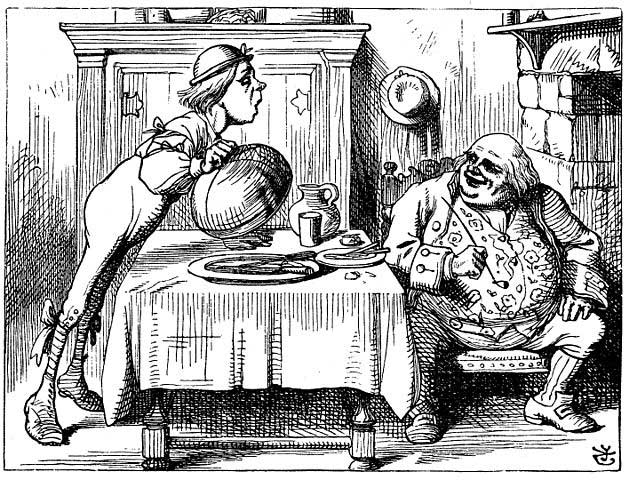
Father William

No one made me memorize “Father William” by Lewis Carroll. I just wanted to because I liked it. I still do.

Here’s another of my favourite poems from even earlier in my life. I came to know it, and “Father William” too, through a big fat book called The Illustrated Treasury of Children’s Literature.It has a light blue, hard cover and a dark blue spine, and an inscription inside it reveals that it was a gift to my brother in 1955 but it somehow, some years ago, came to be in my possession. Don’t tell him. I don’t want to have to give it back.

The Illustrated Treasury of Children’s Literature

The Goops

That’s “The Goops”, originally from Goops and How to Be Them by Gelett Burgess.

Comments (4)
Categories : Speeches
Tags : poetry

Congratulations, You’re #10,995!

By Kathy · Comments (2)
Wednesday, October 31st, 2012

athlete winning a marathon This month Amazon added a “new feature” to “make it easy for readers to discover the best-selling authors”. Excuse me, but is there a literate person on Earth who needs Amazon to tell them that the Twilight series sells more books than the Our Canadian Girl series, or that R.L. Stine sells more books than Kathy Stinson. “Kathy Who? #10,995? Why would I bother reading her books?”

By the way, I make no apology for not providing links to the more popular books and authors referred to here. They don’t need my help! Clearly, ranking at 10,995, I do! 10,995 of how many, I can’t help wondering. 11,000?

This ranking, even if the total number is much higher than 10,995, could be pretty depressing. Except (frankly amazon) I don’t care. Sure I’d enjoy seeing my books earn the kind of income that comes with being a “Top 100”; I bet even “Top 1000” would be nice. But with What Happened to Ivy now on bookshelves and with a wonderful illustrator hard at work on my next picture book, scheduled for publication next year, I’m launched into a new project. And that means all the fun of discovering new characters, figuring out what makes them tick, how they’re linked, the dynamics between and among them, where their stories will begin, and where they’ll end. Way more fun than worrying about how I rank in relation to other authors.

On a recent drive into Toronto, I listened to a podcast of Ideas: Writing from the Rock. At one point in the conversation, the Newfoundland writers got onto the subject of competition among writers, a good thing or a bad thing? I had to agree with the writer who thinks it’s more harmful than destructive. (I’ll leave it to you to listen, to see who that was, and who thought otherwise, and why.) I know that times during my career when I couldn’t resist comparing my achievements to others have inevitably proven to be among my most unhappy times as a writer.

I’ve used a number of strategies over the years to keep myself from slipping into the comparison game, when something like an award announcement or an email from Amazon about a new feature threatens to invite me back into it. One of them is recalling a poster I read in a school library I was visiting that said something like:

“How quiet the woods would be, if no bird sang except the best.”

Writing this blog post, I searched online, to see if I could find that poster. I didn’t find it, but I found another quote to add to my resist-the-comparisons arsenal:

“Who you are isn’t up to them.”

Right. Who I am is up to me. Who you are is up to you. I’m a writer, a good one. Are you a good writer, too? Good. Let’s go write.

Comments (2)
Categories : Kathy Stinson Books, Writing
Tags : inspiration, self-acceptance, What Happened to Ivy
« Previous Page
Next Page »

Introducing: The Man With the Violin

Blog Categories

© All Rights Reserved. Unless otherwise indicated, all blog content (except comments by others) copyright Kathy Stinson. Educators need not purchase a license for use, if already covered by an Access Copyright permission.

What Kathy’s Been Reading

Kathy's bookshelf: read

Astray The Art of Fielding The End of Your Life Book Club The White Bicycle Waiting For No One My Book of Life by Angel

More of Kathy's books »
Book recommendations, book reviews, quotes, book clubs, book trivia, book lists
Copyright © 2002-2013 Kathy Stinson. All Rights Reserved.
Website by Organized Assistant